Local Warehouse Fast Dispatch3–7 Working Days DDP DeliveryFree Customization Support
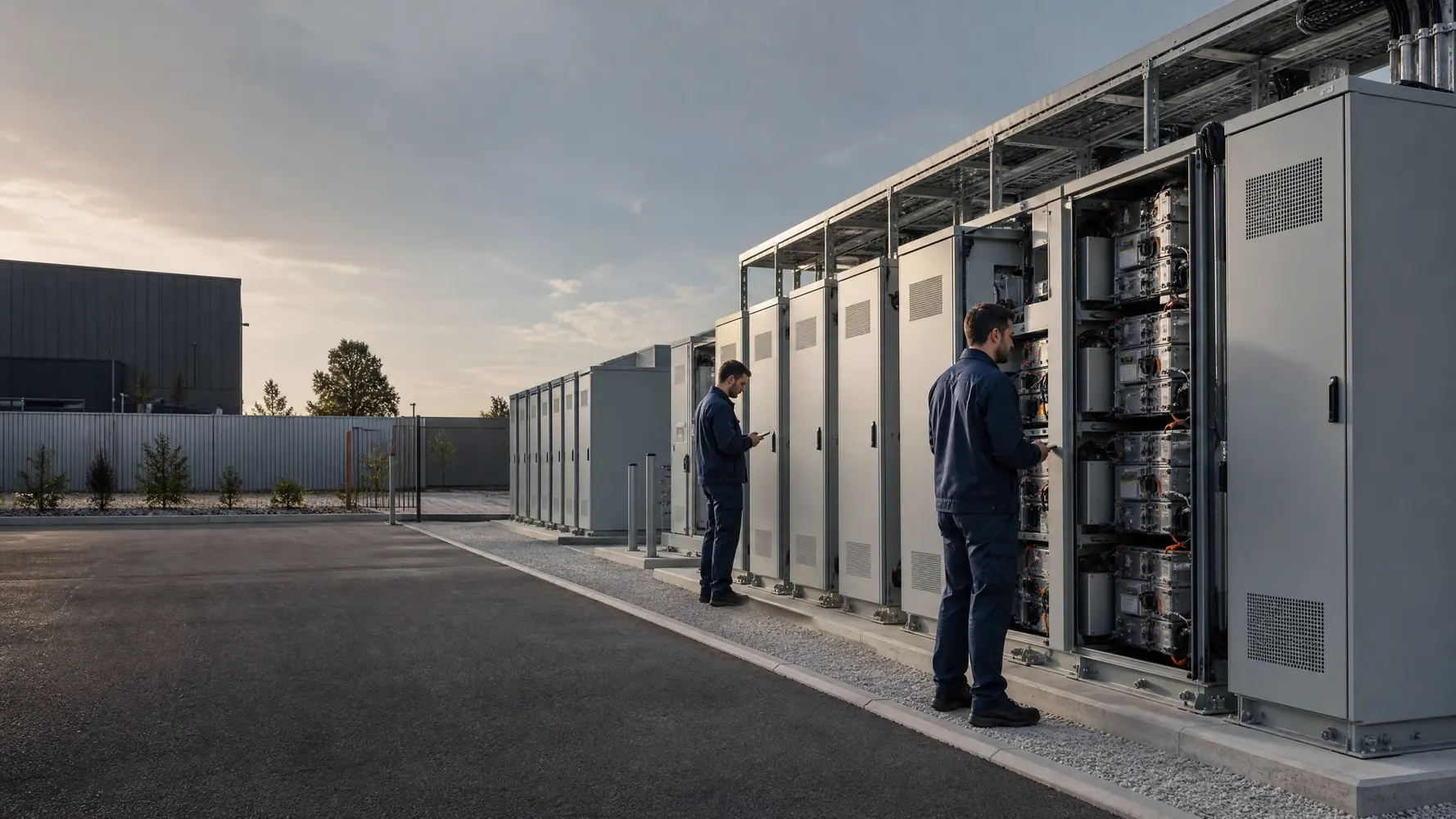
Commercial & Industrial ESS industrial application visual

High-Performance Commercial & Industrial ESS LiFePO4 Battery Solutions for Industrial Fleets, Buildings & Grid Peak-Shaving

Commercial and industrial ESS solutions engineered for scale, reliability, and predictable European deployment. High-voltage BMS with CAN/RS485 mapping for inverter and EMS integration, Grade A cell supply chain, Poland Local Warehouse support for scheduled multi-site rollouts, and duty-free B2B fulfillment for European buyers.

Cells
Packs
ESS

Situation

Your team is procuring LiFePO4 energy storage for a commercial building, factory, or industrial fleet and needs a system that scales to your power and energy targets, meets inverter and EMS integration requirements, and ships on a predictable European schedule.

The Challenge

Industrial ESS projects carry high supply-chain risk. Long ocean freight lead times, undocumented cell sourcing, and BMS/inverter protocol mismatches delay commissioning and inflate total cost of ownership. Without a Grade A cell supply chain and local warehouse support, rollout planning across multiple sites becomes difficult to lock down.

How do you select a commercial and industrial ESS LiFePO4 battery system with Grades A cells, inverter/EMS integration, and predictable EU deployment schedules?

Our Answer

SSLBATT Commercial & Industrial ESS delivers Grade A cell LiFePO4 systems engineered for scale, with 6000+ cycle life, high-voltage BMS, and factory-tested CAN/RS485 mapping for inverter and EMS integration. Poland Local Warehouse support and duty-free B2B fulfillment reduce replenishment risk and compress European deployment timelines. Send voltage, kW, kWh, peak current, and inverter model during technical review and we return a system-fit recommendation with a factory-direct quote.

Grade A Cell Supply Chain

Grade A Cells support tighter module consistency, more stable long-term dispatch behavior, and lower lifecycle risk in high-value ESS assets. Cell sourcing is documented and traceable through the pack build.

EMS and Inverter Integration

Protocol planning and mapping validate the CAN/RS485 handshake and parameter alignment against your inverter and EMS before shipment, so the battery communicates correctly from first power-on.

European Deployment Schedules

Poland Local Warehouse planning reduces replenishment risk and supports scheduled deployments across multiple sites with clearer procurement timing for qualified partners.

Project Economics: kWh Throughput, Demand Charges, and Deployment Certainty

Stationary storage earns its keep on the tariff sheet: peak-demand reduction, solar self-consumption, and dispatch revenue — provided the system meets its commissioned capacity on day one and still meets it in year ten.

kW
Peak Shaving

Discharge against demand-charge windows so the facility's grid draw stays under the tariff breakpoint.
100%
Solar Self-Consumption

Store midday PV surplus and dispatch it into evening peaks instead of exporting at wholesale rates.

6000+
6000+ Cycles at 80% DoD

Daily cycling for 10+ years — degradation curves documented per batch, not estimated.

MW
Scalable Architecture

Rack-level building blocks scale from hundreds of kWh to containerized MWh-class systems.

Undocumented Supply vs. SSL C&I ESS: What Gets Verified

For buyers: cell provenance, commissioning behavior, degradation tracking, and deployment certainty — the four risks that separate a bankable ESS asset from a warranty dispute.

Legacy Option
Undocumented Supply
Capacity you can't verify
Cell Provenance
Unlabeled or B-grade cells rewrapped as Grade A; capacity claims unsupported by batch test data.
Commissioning
Protocol mismatches surface at first power-on — SOC drift, charge faults, silent shutdowns.
Degradation
Impedance spread across modules forces uneven aging; year-five capacity falls short of the model.
Deployment
Ocean-freight lead times and customs friction make multi-site rollout dates un-lockable.
Recommended
SSL C&I ESS
Documented from cell to rack
Cell Provenance
Traceable Grade A cells with incoming acceptance testing and per-batch capacity/impedance documentation.
Commissioning
CAN/RS485 handshake validated against your inverter and EMS before shipment — correct from first power-on.
Degradation
Pack-level formation matching keeps module impedance tight, so capacity tracks the model across the fleet.
Deployment
Poland Local Warehouse stock and 3–7 Days DDP replenishment keep multi-site rollout dates lockable.

Typical Deployment Scenarios

Configuration patterns we engineer for — matched to your duty cycle and site constraints. View all case studies →

Request OEM Quote
Installation photo coming soon
Rack-mounted ESS cycled daily against demand tariffs with EMS-scheduled charge windows.
Scenario 1
Peak Shaving for Manufacturing Plants
Installation photo coming soon
Modular racks pair with commercial inverters through CAN or RS485 monitoring links.
Scenario 2
Solar Self-Consumption Retrofit
Installation photo coming soon
Racks sized for islanded operation hold critical loads until generator handoff.
Scenario 3
Backup Power for Critical Loads
Installation photo coming soon
20-ft container ESS with integrated thermal management and remote EMS monitoring.
Scenario 4
Containerized Microgrid Deployment
Installation photo coming soon
Battery buffers absorb DC fast-charger demand spikes within grid connection limits.
Scenario 5
EV Charging Buffer Storage
Installation photo coming soon
Dispatchable state-of-charge bands aligned to utility DR event schedules via EMS.
Scenario 6
Demand Response Program Integration

Engineered for Your System

Recommended products for Commercial & Industrial ESS. Each option is configurable for voltage, capacity, connector, and BMS communication.

Product image coming soon
High Voltage / Custom

High-Voltage ESS Quote Support for OEMs | SSLBATT

ESS projects need stable rollout planning. SSLBATT adds Poland Local Warehouse, Grade A Cells, and Request OEM Quote support for B2B teams.

OEM
Voltage
High Voltage
Capacity
Custom
Cycle life: 6000+ cycles
View Specs
Integration Checklist
Send these 6 items to get a correct quote (fast)

Required voltage, peak current, average load, charger model, enclosure constraints, and communication needs (CAN/RS485).

Request OEM Quote
B2B Lead Form

Ready to Upgrade? Talk to a Battery Engineer.

We respond with a system-fit recommendation (voltage/capacity/BMS/charger profile) and a factory-direct quote.

What you get
Engineering fit check
BMS + charger compatibility
Commercial offer
MOQ / 3–7 Days DDP / Poland Local Warehouse
Faster procurement
Clear specs & BOM notes
Submit Request
Tell us your application

We respond within 1 business day.

FAQ

FAQ: Commercial & Industrial ESS

Quick answers for procurement and engineering teams.

What inputs do you need to size a commercial and industrial ESS battery system correctly?
We need target DC bus voltage, power (kW), energy (kWh), peak/continuous current, inverter model, and monitoring/EMS requirements. These inputs drive architecture, BMS limits, and thermal design.
Do you support CAN/RS485 mapping for inverter and EMS integration in a LiFePO4 ESS project?
Yes. We support protocol planning and mapping when required, validating the CAN/RS485 handshake and parameter alignment against your inverter and EMS before shipment, so the battery communicates correctly from first power-on.
Can SSLBATT support European ESS deployment schedules with Poland Local Warehouse planning?
For qualified European programs, our Poland Local Warehouse supports 3–7 Days DDP delivery with duty-free fulfillment. Scheduled deployments across multiple sites benefit from clearer procurement timing and reduced replenishment risk.
Why do Grade A Cells matter in C&I ESS programs?
Grade A Cells support tighter module consistency, more stable long-term dispatch behavior, and lower lifecycle risk in high-value ESS assets. Cell sourcing is documented and traceable through the pack build.